Furniture
MARTELL GALLERY


Maxime old
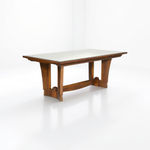
Dining table with mirror top, 1945
walnut and mirror.
Location: Madrid
Location: Madrid
180 cm length x 100 cm Width x 72 cm Height
Location: Madrid
Location: Madrid
A2130
Further images
-
(View a larger image of thumbnail 1
)

-
(View a larger image of thumbnail 2
)

-
(View a larger image of thumbnail 3
)

-
(View a larger image of thumbnail 4
)

-
(View a larger image of thumbnail 5
)

-
(View a larger image of thumbnail 6
)

-
(View a larger image of thumbnail 7
)

-
(View a larger image of thumbnail 8
)
Rectangular dining table by Maxime Old with a mirror top set into a crisp wooden apron. Two flared, open-frame supports joined by a shaped central stretcher give the piece a...
Rectangular dining table by Maxime Old with a mirror top set into a crisp wooden apron. Two flared, open-frame supports joined by a shaped central stretcher give the piece a quietly sculptural, late Art Deco modernity.
Maxime Old (1910–1991) was a French interior architect and furniture designer who trained at the École Boulle and in the atelier of Jacques‑Émile Ruhlmann, before taking over his family’s cabinetmaking workshop in Paris. Celebrated as a “missing link” between luxurious 1930s Art Deco and postwar modernism, he combined impeccable traditional craftsmanship with simple, pure lines and a strong concern for function and comfort. Refined geometric proportions and restrained ornament, often with gently flared supports, sculptural bases, and impeccably resolved junctions rather than applied decoration, the use of rich woods and high-quality materials, treated with a calm, almost architectural sobriety rather than ostentatious inlay or marquetry.
Maxime Old (1910–1991) was a French interior architect and furniture designer who trained at the École Boulle and in the atelier of Jacques‑Émile Ruhlmann, before taking over his family’s cabinetmaking workshop in Paris. Celebrated as a “missing link” between luxurious 1930s Art Deco and postwar modernism, he combined impeccable traditional craftsmanship with simple, pure lines and a strong concern for function and comfort. Refined geometric proportions and restrained ornament, often with gently flared supports, sculptural bases, and impeccably resolved junctions rather than applied decoration, the use of rich woods and high-quality materials, treated with a calm, almost architectural sobriety rather than ostentatious inlay or marquetry.