


Decoration Interieure Modernes (DIM)
Art Deco Chair, 1925
Wood and Fabric
Location: Madrid
White-glove shipping available worldwide. Contact for quote.
Location: Madrid
White-glove shipping available worldwide. Contact for quote.
87 cm height x 89 cm depth x 68 cm width
A2066
Further images
-
(View a larger image of thumbnail 1
)

-
(View a larger image of thumbnail 2
)

-
(View a larger image of thumbnail 3
)

-
(View a larger image of thumbnail 4
)

-
(View a larger image of thumbnail 5
)

-
(View a larger image of thumbnail 6
)
-
(View a larger image of thumbnail 7
)

-
(View a larger image of thumbnail 8
)

-
(View a larger image of thumbnail 9
)

-
(View a larger image of thumbnail 10
)

An elegant French Art Deco club chair attributed to Décoration Intérieure Moderne (D.I.M.), the influential Parisian maison founded by René Joubert and joined by Philippe Petit in 1924. The chair...
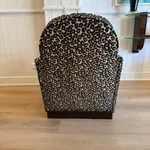
An elegant French Art Deco club chair attributed to Décoration Intérieure Moderne (D.I.M.), the influential Parisian maison founded by René Joubert and joined by Philippe Petit in 1924. The chair embodies D.I.M.'s signature cubist vocabulary: a strict, architectural box silhouette softened by a generous arched shield back that rises gracefully above squared, low-set arms. Polished mahogany blade-form uprights frame the upholstered panels at each front corner, lending the piece the sculptural, almost architectonic clarity for which Joubert and Petit were celebrated. The whole sits on a beautifully executed fluted (gadrooned) mahogany plinth that wraps the perimeter of the base — a refined detail recurrent in documented D.I.M. seating of the late 1920s and early 1930s.
The proportions are quintessentially Parisian moderne: compact in footprint yet deeply comfortable, with a fully sprung seat, loose cushion, and enveloping back. The chair has been sympathetically reupholstered in a striking leopard-print velvet that animates the disciplined geometry of the frame — a thoroughly contemporary choice that nonetheless honors the playful luxury of the period, as the original D.I.M. ateliers frequently paired severe cabinetry with bold, tactile textiles. The mahogany frame retains a warm, hand-rubbed French polish.
Décoration Intérieure Moderne (D.I.M.) was founded in Paris in 1914 by René Joubert and reorganized in 1924 when Philippe Petit joined as co-director, becoming one of the defining ensembliers of the French Art Deco movement alongside Ruhlmann, Süe et Mare, Leleu, and their near-contemporaries at Dominique and Saddier. The firm made its international reputation at the 1925 Exposition Internationale des Arts Décoratifs et Industriels Modernes in Paris — the exhibition that gave Art Deco its name — and went on to furnish prestigious private commissions and ocean-liner interiors through the late 1920s and 1930s. D.I.M.'s aesthetic is recognizable for its cubist rigor softened by sensual curves, its mastery of rare woods (mahogany, palisander, sycamore, amboyna), and its understated luxury — qualities that distinguish the present chair and make seating from this maison increasingly sought after by collectors of authentic French moderne design.
The proportions are quintessentially Parisian moderne: compact in footprint yet deeply comfortable, with a fully sprung seat, loose cushion, and enveloping back. The chair has been sympathetically reupholstered in a striking leopard-print velvet that animates the disciplined geometry of the frame — a thoroughly contemporary choice that nonetheless honors the playful luxury of the period, as the original D.I.M. ateliers frequently paired severe cabinetry with bold, tactile textiles. The mahogany frame retains a warm, hand-rubbed French polish.
Décoration Intérieure Moderne (D.I.M.) was founded in Paris in 1914 by René Joubert and reorganized in 1924 when Philippe Petit joined as co-director, becoming one of the defining ensembliers of the French Art Deco movement alongside Ruhlmann, Süe et Mare, Leleu, and their near-contemporaries at Dominique and Saddier. The firm made its international reputation at the 1925 Exposition Internationale des Arts Décoratifs et Industriels Modernes in Paris — the exhibition that gave Art Deco its name — and went on to furnish prestigious private commissions and ocean-liner interiors through the late 1920s and 1930s. D.I.M.'s aesthetic is recognizable for its cubist rigor softened by sensual curves, its mastery of rare woods (mahogany, palisander, sycamore, amboyna), and its understated luxury — qualities that distinguish the present chair and make seating from this maison increasingly sought after by collectors of authentic French moderne design.
4
of
4
Join our mailing list
* denotes required fields
We will process the personal data you have supplied in accordance with our privacy policy (available on request). You can unsubscribe or change your preferences at any time by clicking the link in our emails.